
 Instagram
英文
| 中文
41 results found
定義: A code-mixing term used by native Hong Kongers to refer to the set of qualities and background that a person has, which may not be what people are looking for in a relationship.
用法: E.g. 康堤package非常之好 比個ex咁公開放暗箭都冇出聲好有品 (Constance Chan's package is very good and she did not even say much when her ex-boyfriend back-stabbed her so openly.)
同義詞: 個人條件
參考: https://www.threads.com/share/BARuUezR1c
定義: (verb) Originated from 'pick-up artist', this is a code-mixing term used by native Hong Kongers to refer to being emotionally manipulated by controlling behaviour of a person who is good at pick-up and chasing the opposite sex.
用法: E.g. 作為女性 聽到Juliana咁講 都覺得幾心酸 究竟之前一齊過幾年嘅ex 係點對待佢 令到佢覺得自己咁卑微 仲要傻到幫對方諗藉口 怪自己有問題 講真唔理係咪節目效果 聽落似係被PUA過 (As a female hearing what Juliana had to say, I feel quite sad to know that she had an ex-boyfriend who treated her like this while spending several years together. He just made her feel like low status and stupid enough to help the other person think of excuses and to blame herself for the problems. Honestly, I don't care if it is the effect of the TV show, but it sounds like she was PUA'ed before.)
同義詞: 被精神操控
參考: https://www.threads.com/share/BA2LSDyu6S/
定義: A code-mixing term that native Hong Kongers use to refer to the new generation of electric multiple unit trains in the Hong Kong MTR produced by CRRC Qingdao Sifang.
用法: E.g. 成型友大嗌Q train萬歲,搞到我差D以為Q train有還不完的恩情。(My friends kept shouting "Long live Q train!" which almost made me think Q train had an endless debt of gratitude to repay.)
同義詞: 市區綫願景列車
定義: Originated from Japanese TV show, this is an Englishised code-mixing term used by westernised Hong Kongers to refer to a teenage-like person who often only lives in their own world and does things just to satisfy themselves, or even acting as if they have secret powers.
用法: E.g. 鍾培生吊威也求婚女友未say yes硬戴戒指網民:太中二了 (Derek Chung proposed to his girlfriend with a wire stunt and put the ring on her while she has not even said yes. Netizens commented: "Such secondary two syndrome!")
同義詞: 中二病
參考: https://www.facebook.com/reel/1239684264415029/
定義: A code-mixing term used by native Hong Kongers as a more abstract way of referring to a person's relationship status without a partner than emphasizing the physical body as ‘單身’ denotes in Cantonese. Even though 'dog' is seen as a derogatory term, the phrase is often treated as a common everyday joke than it is really mocking someone seriously.
用法: E.g. 無論班女仔fd幾大班,三個又好,五個又好,十幾個又好,都係得我係single dog (No matter how big my group of female friends is, three or five or ten, I am the single dog.)
同義詞: 單身狗
參考: https://amp.lihkg.com/thread/708381/page/1
定義: Often pronounced without the 'd', this is a neutral-sounding code-mixing term used by native Hong Kongers when they are not sure which Cantonese equivalent word to use when something unexpected happens.
用法: E.g. 哇,你考試咁高分,我好surprised呀。(Wow, you scored a high mark in your exam. I'm so surprised.) E.g. 哇,你最近減肥呀?我好surprised呀。 (Wow, you went on a diet recently? I'm so surprised.) E.g. 哇,你有男朋友?我好surprised呀。(Wow, you got a boyfriend? I'm so surprised.)
同義詞: 驚喜,驚訝
參考: https://tsangyoksing.hk/2009/10/06/輕音節的正確讀法/
定義: A code-mixing term used by native Hong Kongers to refer to the leisure time spent with others, which can get very intimate depending on the type of relationship.
用法: E.g. 有結婚打算但未有生小朋友想法 鍾意比較痴身男朋友(見面頻率1星期2日左右),享受we time~ (I plan to get married, but I have not thought about having children. I prefer a boyfriend who is quite affectionate and likes to be close (wants to see each other about twice a week), and enjoys having "we time".)
同義詞: 共同時間; 我們時間
參考: https://www.threads.com/share/BAZFf5_OJi
定義: A way to sound more certain and less hesitant when your friend/boyfriend/girlfriend is asking you whether you want to do something with him or her.
用法: E.g. 朋友: 聽日去唔去睇戲呀? 你: Depends啦。 E.g. 女朋友: 係咪聽日去shopping呀? 你: Depends啦。 E.g. 女朋友: 係咪聽日去shopping呀? 你: 睇下點啦。 *啪!*
同義詞: 睇下點
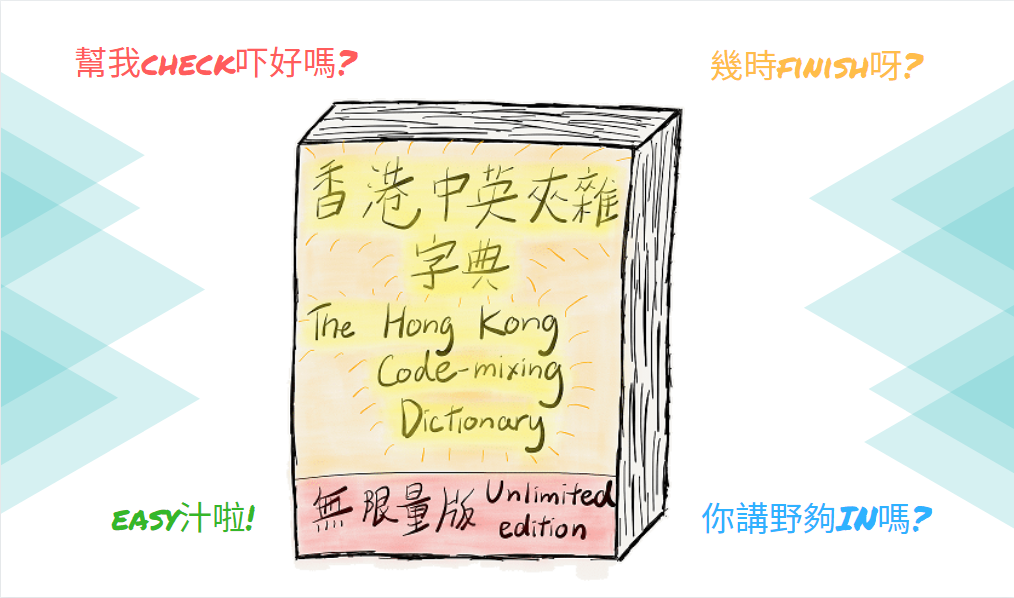
定義: A jubilant, nonchalant way of showing off to your friends. Used together with 'juice' in Cantonese.
用法: E.g. 哎呀!今次唔洗溫書都實pass啦!Easy汁啦!
同義詞: 容易
定義: Known as Kongish, this is a code-mixing phrase used by native Hong Kongers to refer to a man who relies on his wife or girlfriend to sustain a living.
用法: E.g. Be a real man and stop eating soft rice!
同義詞: 食軟飯